
Jan 5, 2026
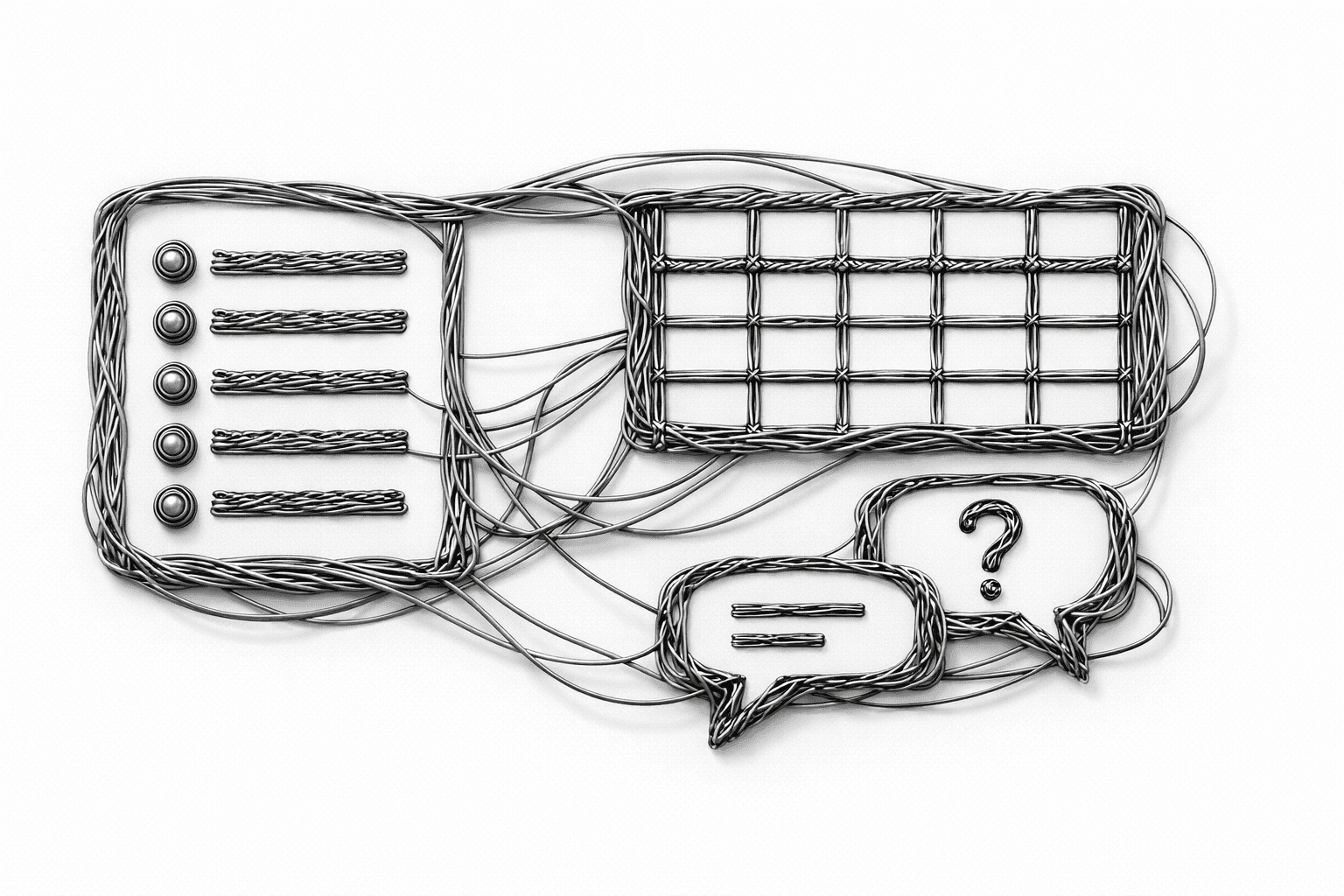
When we talk about "ranking" in ChatGPT, it's important to align expectations from the start. It is not about traditional SEO, fixed positions, or search result pages like on Google. It is about the likelihood of content being retrieved, selected, and used as evidence within large-scale language model-based systems.
These systems evaluate clarity, structure, and reliability of information. Therefore, the way content is organized directly influences whether it will be used or ignored in an AI-generated response.
What does ranking mean in ChatGPT?
Ranking in ChatGPT means being retrieved and used as relevant evidence to answer a specific question.
There is no ordered list of pages. What exists is the selection of informational snippets that make sense in the context of the user's question.
In practice, this depends on:
Semantic clarity
Content structure
Ease of information extraction
Alignment with real questions
How do AI systems process content before responding?
Before a language model uses a text, it goes through technical stages that determine whether that content is useful or not.
What is the extraction and parsing stage?
Extraction is the process by which the system identifies and separates the different elements of a document.
In this stage, the model tries to distinguish:
Main content
Headings and subheadings
List items
Comparative structures and tables
Secondary elements like menus and footers
Well-structured content facilitates this reading because it makes the boundaries between ideas, definitions, and conclusions explicit.
Continuous texts, on the other hand, mix concepts and hinder the identification of clear informational units, reducing the reliability of the content for later use.
Why does content segmentation affect retrieval so much?
Modern systems divide documents into small blocks of text to facilitate internal searches for relevant information.
What are content blocks?
Blocks are short excerpts, typically between 200 and 800 tokens, that need to make sense independently.
Lists and sections of questions and answers work better because each item tends to represent a complete semantic unit. This increases the informational density of each block and improves retrieval.
In long and continuous texts, several ideas end up grouped in the same block. Since this process works as a form of compression, the lack of structure makes information loss much more likely.
How does clarity affect embeddings and semantic similarity?
Each content block is transformed into a numerical vector that represents its meaning.
The quality of this representation depends on factors such as:
Clarity of the topic
Concentration of relevant terms
Low semantic ambiguity
Structured content produces more accurate vectors because it makes explicit relationships such as question and answer, item and description, attribute and value.
Continuous texts often depend on implicit context, pronouns, and indirect references, which results in representations that are less aligned with direct questions posed by users.
Why are lists and comparisons favored in reordering?
After retrieving potential relevant snippets, many systems apply a reordering to decide which evidence is most useful for the final response.
Enumerated lists, explicit comparisons, and tables tend to have an advantage because:
They correspond directly to the intent of the question
They require less inference from the model
They locate evidence objectively
When the answer is clearly visible, the system assigns greater relevance. In continuous texts, information is diluted and requires more interpretative effort, which tends to be penalized.
How does structure guide the model's attention?
Transformer-based models use attention mechanisms to decide which parts of the text deserve more focus.
Structural elements act as natural guides of attention, such as:
Numbering
Bullet points
Explicit questions
Headings and subheadings
Linearized tabular structures
These markers help the model segment content, understand internal relationships, and reduce ambiguity. In long and continuous texts, the risk of dispersion and loss of focus is higher.
Why is structured content easier to summarize?
Even when no external retrieval is involved, the model needs to summarize large volumes of text internally to generate a response.
Organized content facilitates:
Extraction of key points
Enumeration of arguments
Objective comparisons
Generation of direct answers
This reduces the chance of omissions, generic answers, or inaccurate information.
What is the role of tables in AI-generated responses?
Tables function as small databases.
They present attributes and values explicitly, which facilitates queries such as:
Which is cheaper?
Which has a certain feature?
Which has the lowest rate?
In continuous texts, this same information is scattered, making precise and reusable responses more difficult.
Why do questions and answers perform better?
Users ask direct questions. Models receive direct questions.
Structured blocks in questions and answers:
Reproduce the real language of the query
Provide ready-to-reuse answers
Increase lexical and semantic alignment
This significantly increases the chance of the content being retrieved and used in the final answer.
What really defines good performance in ChatGPT?
In practice, good performance means maximizing four essential factors:
Chance of being found
Relevance of the information
Ease of locating the evidence
Ability to generate clear and reliable answers
Structured content performs better on all these points. Continuous texts tend to lose efficiency at every stage of the process.
What content patterns work best for generative engines?
Some formats consistently demonstrate superior performance:
Enumerated lists with short explanations
"Top N" type sections with clear criteria
Well-defined comparative tables
FAQs based on real questions
Explicit definitions in the format "X is..."
Clear titles and subtitles focused on attributes
Frequently Asked Questions (FAQ)
Can long texts appear in ChatGPT?
They can, but have a lower chance if not well structured and segmented.
Do lists really make a difference?
Yes. They create clear informational units, easier to retrieve and reuse.
Do questions and answers really help?
Yes. This format aligns directly with user behavior and how models operate.
Is structure more important than depth?
No. Structure and depth need to coexist. Deep but disorganized content tends to perform poorly.
Conclusion
In systems based on generative artificial intelligence, structure is not aesthetics. Structure is a signal.
Organized content, with clear definitions, lists, questions, and explicit comparisons, has a higher chance of being retrieved, understood, and used as evidence in AI-generated responses. For brands, creators, and companies, organizing information well has become a decisive factor for visibility.