
Jan 6, 2026
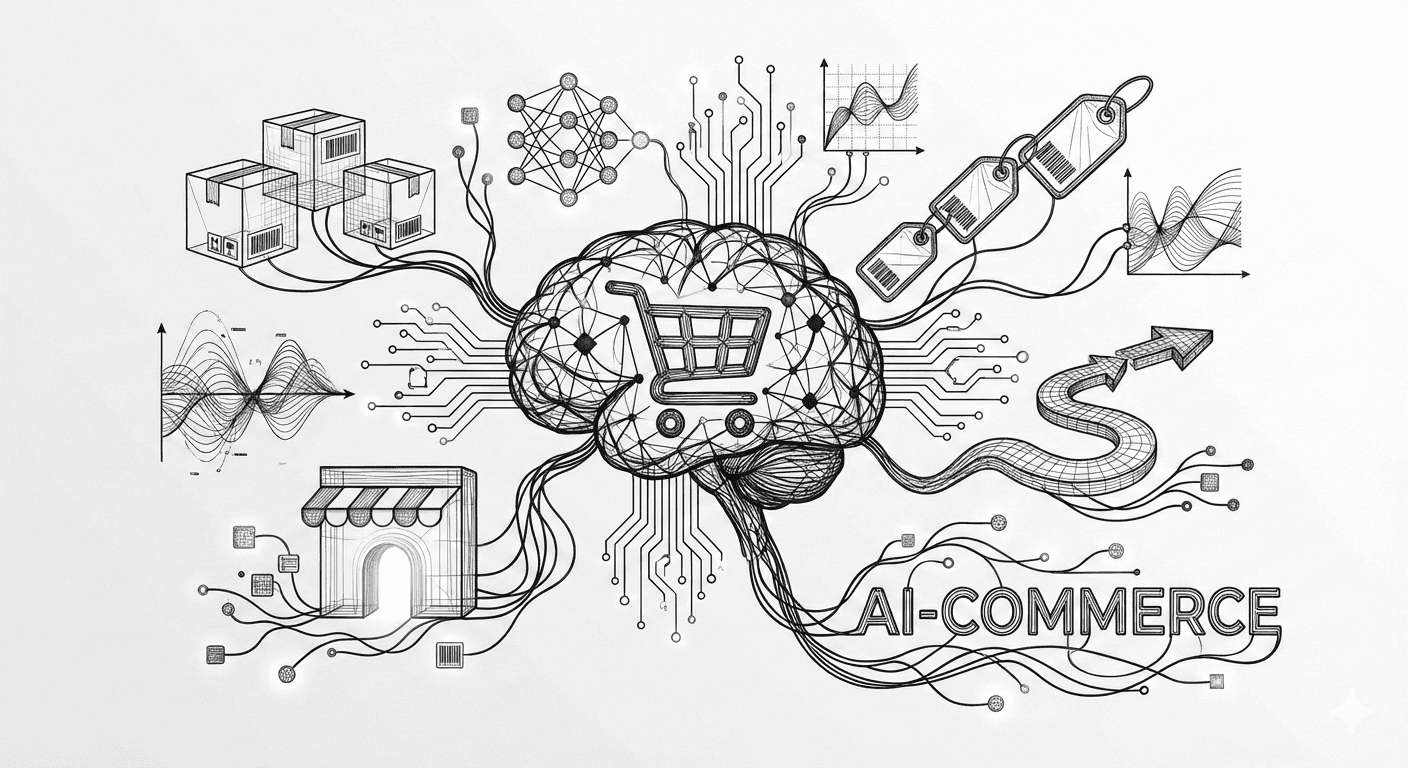
What is AI-Commerce?
AI-Commerce is the use of artificial intelligence to personalize experiences, recommend products, and automate decisions throughout the entire buying journey in e-commerce.
It connects data, algorithms, and channels to transform interactions into smarter business actions.
Why is AI-Commerce the new frontier of e-Commerce?
What has changed in online shopping behavior?
Consumers have started making decisions with the support of AI systems, not just browsing stores.
Conversational searches, automatic comparisons, and personalized recommendations have become part of the shopping process.
AI-Commerce responds to this scenario by:
Reducing friction in decision-making
Anticipating needs
Personalizing at scale
How does AI-Commerce work in practice?
What technologies support AI-Commerce?
AI-Commerce works through the integration of data with artificial intelligence models.
Main technologies:
Machine Learning for intention prediction
Natural language processing for searches and conversations
Intelligent recommendation systems
Predictive analytics for inventory and demand
These systems continuously learn from user behavior.
How do LLMs and AIs participate in e-commerce sales?
Do AIs really influence buying decisions?
Yes. LLMs and AIs act as active intermediaries in the buying journey.
They explain products, compare options, and suggest choices even before a click in a store.
Main ways of acting:
Product suggestions based on user questions
Automatic comparison of brands and features
Answers to questions about price, use, and delivery
How do product suggestions via AI work?
What makes an AI-generated recommendation effective?
Effective recommendations combine context, intention, and historical data.
They are not limited to popular products but rather to what makes sense at the moment.
Signals used by AIs:
Browsing and purchase history
Questions in natural language
Search context
Explicit and implicit preferences
What is the role of clear content in AI-driven sales?
Does content influence recommendations and responses?
Yes. AIs depend on well-structured content to recommend products and brands.
Confusing descriptions reduce the chance of an offer being used as a response.
Content most used by AIs:
They answer real purchase questions
They explain benefits objectively
They maintain consistency in language and attributes
How does optimization for response engines impact AI-Commerce?
Does answering well help to sell?
Yes. Direct answers reduce doubts and speed up decisions.
When content answers questions clearly, it is more reused by response systems during the buying journey.
Direct impacts:
Fewer unanswered objections
More confidence in the choice
Faster buying decision
How does optimization for generative AI engines connect to AI-Commerce?
Does being cited by AIs influence sales?
Yes. Products and brands cited by AIs gain a competitive advantage.
When an AI chooses a source to explain or recommend something, it directly influences the consumer's decision.
Factors that increase this chance:
Clear content structure
Objective definitions
Consistent language about products and benefits
Does AI-Commerce replace traditional e-commerce?
Does the current model cease to exist?
No. AI-Commerce evolves traditional e-commerce.
The operation continues to exist, but intelligence now guides discoveries, decisions, and conversions.
New competitive standard:
Personalized experience by default
Conversational interaction as a sales channel
AI as the mediator of the decision
What challenges exist in adopting AI-Commerce?
What do companies need to consider?
The adoption of AI-Commerce requires strategy, data, and governance.
Main challenges:
Integration and quality of data
Transparency in AI use
Technological infrastructure
Training of teams
Frequently Asked Questions (FAQ)
How can I get my product recommended by an AI?
Apply Generative Engine Optimization (GEO) techniques.
Is AI-Commerce just automation?
No. It learns from data and makes adaptive decisions.
Do LLMs really influence sales?
Yes. They recommend, compare, and explain products during the buying journey.
Does content impact AI recommendations?
Yes. Clear and structured content is more widely used as a response basis.
What is the relationship between direct answers and conversion?
Clear answers reduce doubts and speed up buying decisions.
Conclusion
AI-Commerce redefines how products are discovered, explained, and sold in an AI-mediated environment.
With LLMs and response systems actively participating in the buying decision, clear, structured, and question-oriented content becomes commercial assets.
The future of e-commerce is conversational, intelligent, and increasingly influenced by how information is understood and reused by AI systems.